
Technical Specifications
- Rosette Material
- Q235B / S235JR steel plate, 8mm / 10mm thick
- Connection Points
- 8 slots (4 large holes + 4 small holes)
- Wedge Material
- Drop-forged high-carbon steel, captive pin
- Rosette Spacing
- 500mm on standard
- Connection Type
- Wedge-lock, hammer-tightened, self-locking
- Surface Treatment
- Hot dip galvanized to ISO 1461
Rosettes & Wedges
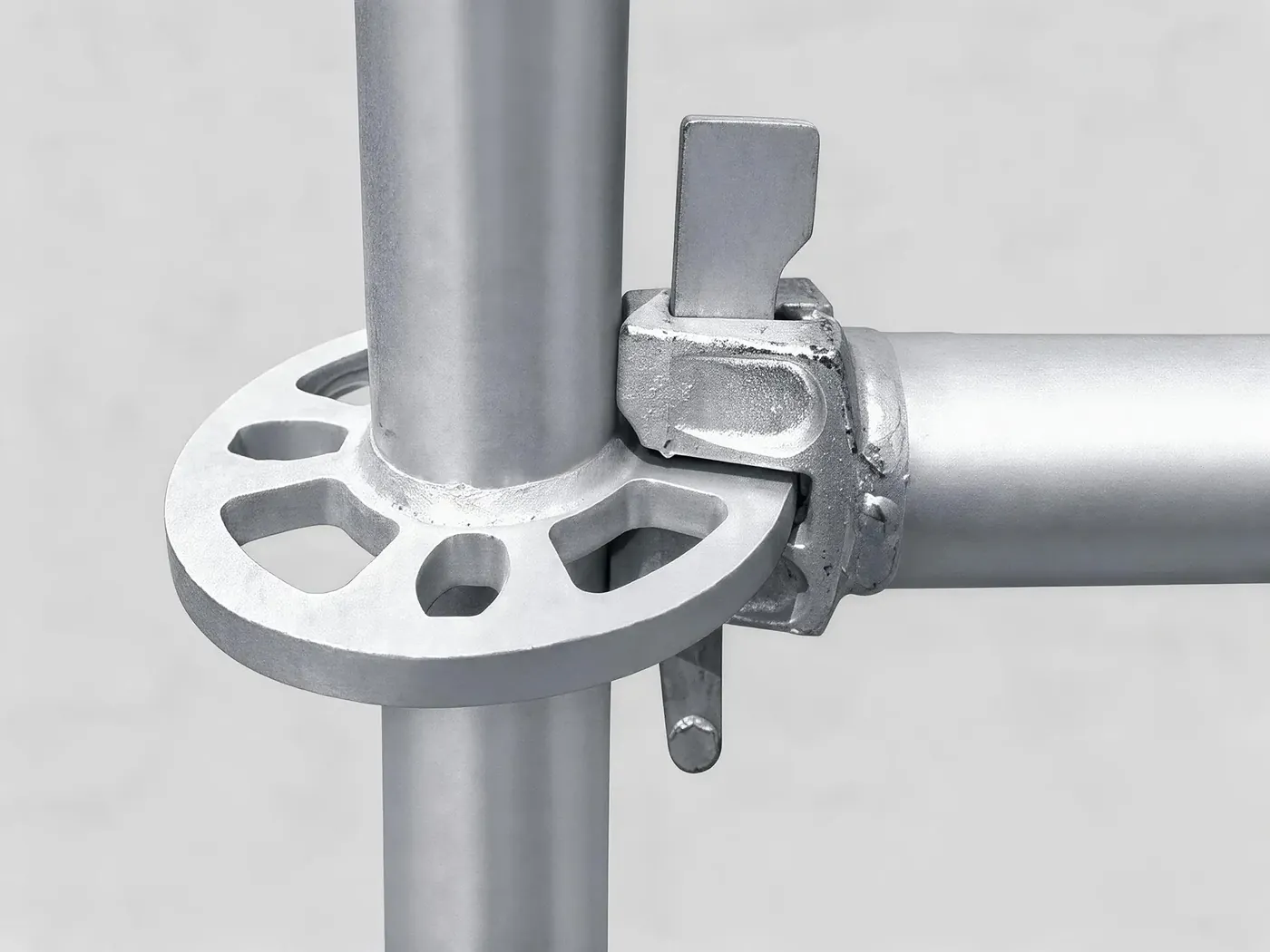
On site, ringlock rosettes are often simply called scaffold rings — the ring-shaped plates welded to every standard that give ring lock scaffolding its name.
Ringlock rosettes and wedges are the critical connection components that make the ringlock scaffolding system possible. The rosette is a circular steel plate, 123mm in diameter, with 8 precisely machined slots — 4 large slots for ledgers and 4 small slots for diagonal braces — welded to the vertical standard at 500mm vertical intervals. The wedge head fitted to the ends of ledgers and braces engages into these slots and is secured by hammering the captive wedge pin, creating a rigid, self-locking connection that requires no tools and no loose parts.
As a professional ringlock rosette and wedge manufacturer based in Nanjing, China, LuckyScaffolding produces both pressed and forged rosettes to suit different application requirements. Pressed rosettes are cost-effective for standard access scaffolding, while forged rosettes offer superior strength and fatigue resistance for heavy-duty shoring and industrial applications. Our wedges are drop-forged from high-carbon steel with captive pin design that prevents loss during assembly and dismantling.
The rosette connection is what gives ringlock scaffolding its unique multi-directional capability. Unlike cuplock or kwikstage systems that only allow connections at right angles, ringlock rosettes accept connections at any angle, making it possible to build curved scaffolds, circular towers, stair towers, and complex geometric structures with the same standard components.
All our rosettes and wedges are hot dip galvanized for corrosion protection. We supply these components to scaffold manufacturers, rental companies, and repair facilities worldwide.
Key Features
- 8 connection points per rosette: 4 large slots for ledgers, 4 small slots for braces
- Rosette material: Q235B / S235JR steel plate, 8mm standard thickness, 10mm heavy duty
- Self-locking captive wedge: hammer-tightened, no loose parts, no tools required
- Multi-directional connections at any angle for complex scaffold geometries
- Pressed rosettes for economy, forged rosettes for heavy-duty applications
- Hot dip galvanized for long-term corrosion resistance
Rosettes & Wedges Specification Table
Detailed product codes, dimensions, materials, weights with metric and imperial units.
| Code | Item | Outer Diameter × Wall Thickness | Length | Weight | ||
|---|---|---|---|---|---|---|
| Metric | Imperial | KG | LBS | |||
| LS-ROS001 | Ringlock Rosette Standard | Dia. 123mm | 8mm | 0.3" | 0.55KG | 1.2LBS |
| LS-ROS002 | Ringlock Rosette Heavy Duty | Dia. 123mm | 10mm | 0.4" | 0.68KG | 1.5LBS |
| LS-WDG001 | Ringlock Wedge Standard | Forged steel | 48mm | 1.9" | 0.12KG | 0.3LBS |
| LS-WDG002 | Ringlock Wedge Heavy Duty | Forged steel | 48mm | 1.9" | 0.15KG | 0.3LBS |
* Weights are approximate and may vary slightly due to galvanizing thickness. Custom sizes and models available on request.
Frequently Asked Questions
What is the difference between pressed and forged rosettes?
Pressed rosettes are stamped from steel plate using a press die, making them economical for standard access scaffolding. Forged rosettes are hot-forged, giving them a denser grain structure, higher strength, and better fatigue resistance. Forged rosettes are recommended for heavy-duty shoring, high-frequency rental use, and applications where maximum durability is required.
Can damaged rosettes be replaced or repaired?
Rosettes are permanently welded to the standard and cannot be replaced individually. If a rosette is cracked, deformed, or damaged, the entire standard must be taken out of service. This is why we recommend forged rosettes for rental fleets where components experience frequent assembly and dismantling cycles.
Do wedges need to be tightened with a specific torque or tool?
No. Ringlock wedges are designed to be tightened by hammer — typically 2-3 strikes with a standard scaffold hammer. The captive wedge design ensures they self-lock under load and cannot back out. No torque wrench or special tools are needed, which is one of the reasons ringlock is so fast to assemble.
How often do rosettes and wedges need to be inspected?
Under EN 12810 and most national regulations, all scaffold components including rosettes and wedges must be visually inspected before every use. Look for cracks, deformation, excessive wear, or damaged threads. Components showing any of these signs must be removed from service immediately.
Are your rosettes compatible with Layher Allround and other systems?
Yes, our rosettes are dimensionally compatible with all major rosette-based ringlock systems including Layher Allround, Peri Up, MJ, and similar systems. The 123mm diameter, 8-slot pattern, and 500mm spacing are industry-standard dimensions.
Can I buy rosettes and wedges separately for repairing my existing scaffold?
Yes, we supply rosettes and wedges as spare parts for maintenance and repair. However, rosettes must be welded to standards by a certified welder. We recommend purchasing pre-assembled standards with rosettes already welded, or sending your standards to us for rosette welding service.
What causes rosette failure and how can it be prevented?
Rosette failure is usually caused by overloading, impact damage, or fatigue from repeated loading cycles. To prevent failure, always use the correct component grades for your load requirements, avoid dropping components, and inspect rosettes regularly for cracks or deformation. Using forged rosettes significantly reduces fatigue failure risk.
Need a Quote for Rosettes & Wedges?
Send us the models and quantities you need. We reply within 12 hours.